
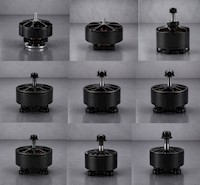
Everline® EV Series motors provide a scalable UAV propulsion portfolio for commercial, industrial, research, and OEM development programs. Engineering support, customization options, and published performance data help streamline propulsion evaluation, integration, and production planning.
The Everline® portfolio covers compact, mid-power, high-output, mission-tuned, and heavy-lift motor platforms. Each series is built on a common mechanical and electrical foundation, so engineers can select the right motor class for each aircraft while keeping the same integration approach.
The EV portfolio supports a broad range of aircraft designs, from micro UAVs and lightweight multirotors to inspection and mapping platforms, payload-carrying systems, VTOL aircraft, and heavy-lift UAVs. Multiple stator classes and KV options provide clear propulsion starting points for different thrust, efficiency, and mission requirements.
Within each series, motors share their mechanical and electrical characteristics, such as stator configuration, frame dimensions, shaft or mounting interface, and cable length. This simplifies system design, speeds up comparison between motor options, and gives aircraft development and testing a consistent foundation.
Published specifications and tested performance data support initial motor screening and OEM evaluation. Available data includes thrust, electrical power, current, RPM, voltage, and efficiency across multiple propeller and battery configurations. This supports aircraft sizing, propulsion trade-off studies, and preliminary motor selection during engineering review.
Every EV Series can be evaluated as a standard propulsion platform and reviewed for production requirements. These include alternate KV targets, cable lengths, connector options, shaft and mounting needs, labeling, documentation, application support, and production integration needs.
Everline® EV Series motors provide scalable propulsion solutions that balance thrust capability, efficiency, and integration flexibility across a broad range of UAV mission profiles. Published performance data and OEM support help simplify product selection, propulsion evaluation, and development planning.
Model Number |
Series |
Speed (up to) |
Idle Current (20V) |
Maximum Power |
Peak Current |
Resistance |
Lead Wires (AWG) |
|---|---|---|---|---|---|---|---|
| EV1404-2900 | N/A EV1400 | N/A 39,300 rpm | N/A 0.5 A | N/A 250 Watts | N/A 10 A | N/A 310 mOhm | N/A 24 AWG |
| EV2810-1100 | N/A EV2800 | N/A 30,100 rpm | N/A 1.8 A | N/A 1,250 Watts | N/A 50 A | N/A 52 mOhm | N/A 18 AWG / 1 mm² |
| EV2812-1100 | N/A EV2800 | N/A 29,100 rpm | N/A 1.4 A | N/A 1,375 Watts | N/A 55 A | N/A 53.4 mOhm | N/A 18 AWG / 1 mm² |
| EV3110-900 | N/A EV3100 | N/A 17,100 rpm | N/A 1.1 A | N/A 950 Watts | N/A 40 A | N/A 73 mOhm | N/A 18 AWG / 1 mm² |
| EV3115-640 | N/A EV3100 | N/A 20,700 rpm | N/A 1.0 A | N/A 810 Watts | N/A 40 A | N/A 72 mOhm | N/A 16 AWG / 1.5 mm² |
| EV3115-700 | N/A EV3100 | N/A 22,000 rpm | N/A 1.1 A | N/A 1,300 Watts | N/A 55 A | N/A 56 mOhm | N/A 16 AWG / 1.5 mm² |
| EV3115-900 | N/A EV3100 | N/A 18,000 rpm | N/A 2.0 A | N/A 1,050 Watts | N/A 45 A | N/A 38 mOhm | N/A 16 AWG / 1.5 mm² |
| EV4215-340 | N/A EV4200 | N/A 10,900 rpm | N/A 1.1 A | N/A 800 Watts | N/A 32 A | N/A 79 mOhm | N/A 14 AWG / 2.5 mm² |
| EV4215-380 | N/A EV4200 | N/A 12,340 rpm | N/A 1.4 A | N/A 1,220 Watts | N/A 51 A | N/A 66 mOhm | N/A 14 AWG / 2.5 mm² |
| EV4215-520 | N/A EV4200 | N/A 17,700 rpm | N/A 2.2 A | N/A 1,900 Watts | N/A 82 A | N/A 43 mOhm | N/A 14 AWG / 2.5 mm² |
| EV4215-710 | N/A EV4200 | N/A 17,740 rpm | N/A 3.5 A | N/A 1,900 Watts | N/A 90 A | N/A 30 mOhm | N/A 14 AWG / 2.5 mm² |
| EV5315-300 | N/A EV5300 | N/A 13,320 rpm | N/A 2.2 A | N/A 2,500 Watts | N/A 52 A | N/A 42 mOhm | N/A 14 AWG / 2.5 mm² |